
Performing Education
Confidence, and the AI Student

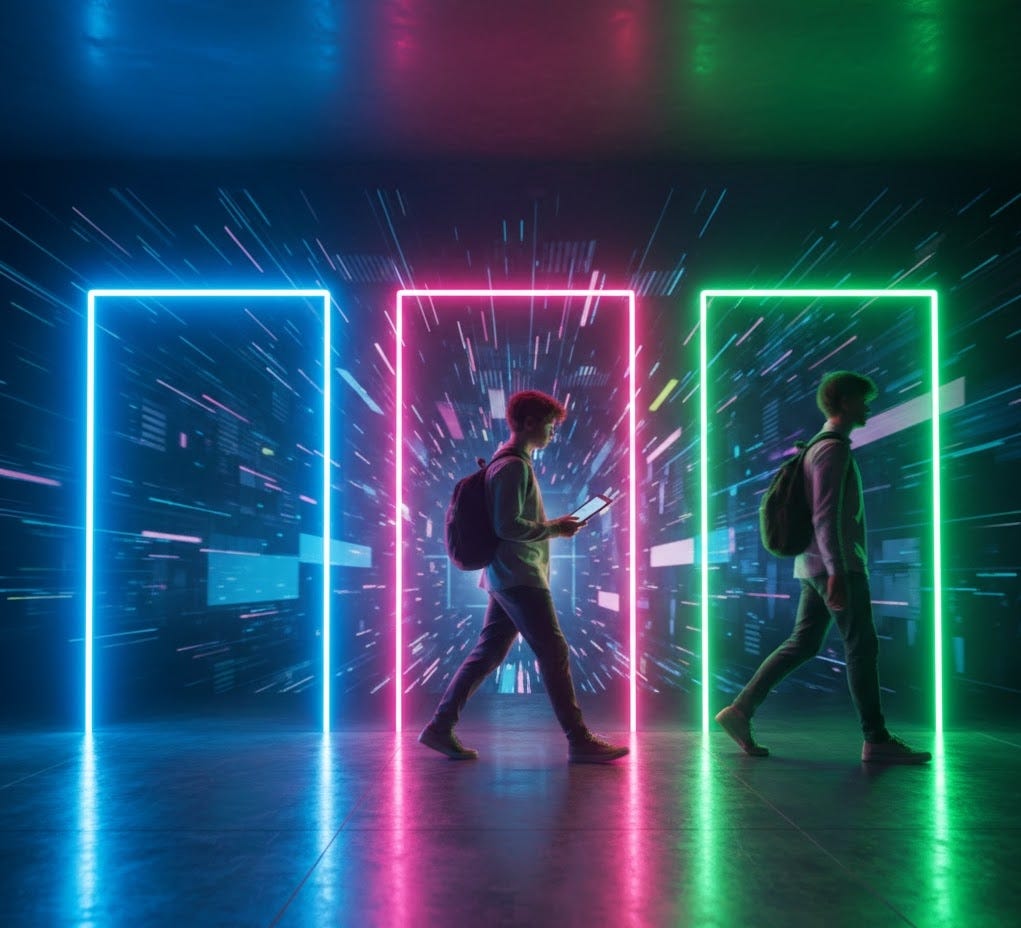
A recent student of mine came to class in curiosity-hyperdrive.
He would raise his hand for every question, take rigorous notes based on students’ comments, and offer insightful responses that raised eyebrows. He’d come in on time, make consistent eye contact, and thank me when the class was over.
The semester rolls on, however, as they tend to do, and the stress begins to build—especially for freshmen. We forget that feeling: moving from a fairly controlled high school environment, where parents, coaches, teachers, and guidance counselors quickly counter your dumbest adolescent impulses, into college, where you’re released with your half‑developed prefrontal cortex and immediately tasked with managing unfettered freedom. Surrounded by other recently freed, similarly underdeveloped teenagers, living in a social laboratory called a dorm with a tuition bill the size of a housing down payment hovering over every decision, students enter a perfect storm of anxiety, liberation, and bad choices.
Some manage. Some don’t. That’s typical.
As a professor, I’ve learned to spot those who are struggling and try to assist. You have one-on-one conversations, calmly show them their grades, and ask them questions about their aspirations. You strategically interfere and hope for the best.
It is here where the students’ fight-or-flight impulse kicks in. They either quickly adjust their behavior to meet course objectives or they disappear, like Homer in the bushes, pretending nothing is really happening.
This disappearance act usually takes shape when students gradually distance themselves from their responsibilities by slipping into a frictionless comfort zone—a space I’ll call the second space. This space is quasi-digital and endlessly distracting, reaffirming students’ worst impulses while calmly diminishing their desire for deeper engagement. In our digital age, this retreat is effortless – escape is right there thanks to platforms clamoring for our attention. Compiling enough distractions in one’s everyday experience, be it through YouTube, Snapchat, or Discord, doesn’t erase academic responsibilities per se, but buries them behind a comforting barrage of curated content. The second space is where the embodied self recedes into the digital domain; it’s where our sense of control is safely outsourced to platform affordances and habitual gestures.
Interestingly, now, I’ve just found out there’s a third space.
The third space is simultaneously real and digital, human and AI—a space that, rather than encouraging withdrawal, appears to imbue students with a sense of confidence. As AI is gradually introduced across educational institutions, students, staff, and educators alike are being asked to (re)imagine what we mean by critical thinking, education, and learning when working with these powerful tools. Doing so requires a few brave AI users to engage in public performances of these traditional concepts. Wearing the mask of “educator” or “critical thinker,” they co-construct these performances with tools like ChatGPT for an imagined audience willing to accept this new, digital collaboration. One student’s paper may be largely written by ChatGPT, yet “learning” is still presented; another student’s slides may be copied from Gemini, yet “confidence” is expressed during the speech.
Did they learn? Were they confident?
If the answer is yes, then, in a way, identity becomes situational, not essential. It echoes Erving Goffman’s assertion that there is no authentic “self” beneath social roles—only a self assembled through interaction. The effect projected by those within the third space reflects this logic. One may not be a “critical thinker” or “educator” in the traditional sense—defined by mastery stored in long-term memory—yet may possess sufficient confidence and contextual knowledge to perform these roles effectively for a particular audience, at a particular moment. Those in this third space proudly wear a mask, not because they are hiding but because social life itself is performative, and they believe themselves to be the actors, constantly on stage. Meaning, authority, and competence are continually negotiated rather than possessed.
I didn’t know at the time, but it was within this third space where my student discussed above suddenly found himself, now buried behind a mountain of late work in the eighth week of the semester. He missed a class here, had a late assignment there. He stopped answering questions in class and glued himself to his computer. “I gotta run,” was what he told me when I tried to talk to him after class, “next time, sorry, I promise.”
Soon, he wasn’t showing up at all, and after some unresponsive emails, I figured he dropped the class. The freshman experience, and all its wild freedom, had become too much.
So I was surprised to see him resurface for the final presentation, eager to present his research to the classroom. I hadn’t read his paper that his presentation was based on–he hadn’t turned it in–but he was here with that original zeal he had brought the first day of my class. So I let him present.
He opened with a fury of loaded terms, staggering through a speech that was both academic, yet distant. Shiny terms like “discourse” and “lens” cleverly shaped each sentence, each starting with a glimmer of potential but trailing off into more banality. No evidence. No substance. The language dazzled without direction—like someone trying to wear every luxury brand at once, yet unable to create a coherent sense of style.
But here’s what I struggled to understand: his confidence was through the roof. His eye contact was strong, and his voice projected, carrying across the room. Certain students perked up when he made strategic pauses, even though his speech was littered with the “it’s not____, it’s ____” phrasing that has been characterizing AI-speak for the past year. I will bet my life that this entire presentation was AI-generated, but for a split second, between him and some of the students, that didn’t seem to matter. From what I could tell, some of them were buying the grift.
Sure, people bullshit their way through things all the time and get away with it. But usually the bullshitter knows they're full of it, and here I couldn’t really tell, given the response he was getting in the class and his own non-verbal reactions. The mask had served its function: he was performing “education” and, in some way, convincing others as well.
The third space is entered through the back door, where confidence, flattery, and something resembling critical thought now conjoin thanks to the use of AI without any critical discernment. In this third space, where one doesn’t have to choose between deep thinking that translates into knowledge or complete ignorance, they can resemble someone who traveled into the depths of a topic and create the vibe that such a journey took place.
And yet the third space is not completely new. We have known about it for thousands of years, harkening back to the early sophists of Athens, who taught rhetorical performance over truth. Early in Plato’s Republic, Socrates debates these sophists one after another, tying their arguments in knots. The sophists perform certainty, while Socrates performs ignorance—claiming that he knows that he does not know, even as he destabilizes their positions. No one “wins” these early arguments in the book, and perhaps that is the point: deep thinking requires the slow deconstruction of false confidence. Eventually, Plato arrives at his claim—that “opinion is concerned with what comes to be and passes away, but knowledge is concerned with what is.” But this distinction forms gradually over the course of the dialogue, emphasizing that knowledge and the appearance of knowledge are so often taken to be the same that they must be patiently peeled apart through the Socratic method.
This distinction is difficult to make these days, particularly as AI tools increasingly mirror the surface features of academic work. For that reason, it is useful to think about how students orient themselves in spatial terms. They move between these spaces—often unconsciously—choosing, at different moments, how to engage with learning. I’d like to imagine that each space shares the same dimensions–the same objects, color schemes, and fixtures are in each space. Eventually, students may not notice the difference between the three, but of course, there is a difference. It’s our job as educators to let them know what space they are in. And to remember, one can only occupy one space at a time.