
Watching ourselves Watching
Love Island in the Arena of Spectatorship

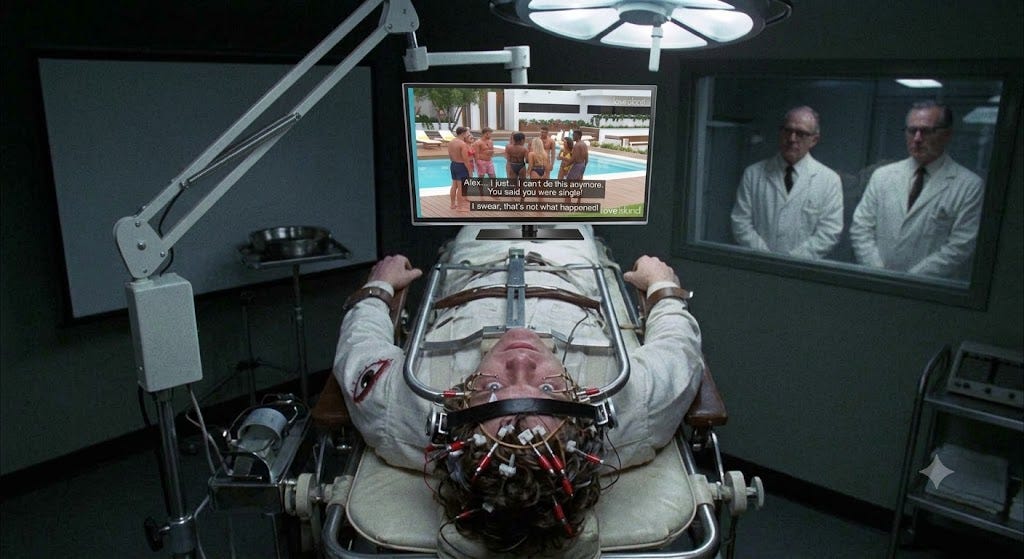
It’s the dead of summer, and out in the remote confines of Fiji Island, contestants are being viewed daily. There is no cell phone use, no TV’s. They boil in the heat and “pull others for a chat.” They meander around a sun-soaked pool all day, pondering each other’s chemistry while navigating what makes each other authentic. Contestants conveniently ignore the irony: that somehow, while all of America watches them, and they know they are being watched, they will somehow discover an authentic love match in a dating petri dish perfectly curated for the audience’s viewing pleasure. We call this experiment Love Island.
Lately I realized the irony isn’t confined to a tropical island, but can feel more personal. I was sitting in a humid 6th train heading south to 59th Street when my eyes moved from my book to the phone screen of the person next to me. He was young, maybe early twenties, rapidly scrolling through Instagram. I quickly saw Knicks fans celebrating in midtown, an advertisement for non-wrinkled button-downs, a skydiver throwing himself off a jagged cliff, and a video of a cat dancing in front of its owner, which this person viewed the longest. About five seconds of the cat video went by, and my thoughts began to wander: why is a young man dressed for a JP Morgan office–Patagonia vest, white-collared shirt, wing tips–placing most of his attention on a dancing cat? Why does the most asinine symbol on the internet–silly cat videos-stir this man of finance over, say, a short clip on the New York Knicks, or humans hurling themselves over jagged rock? That’s weird, right?
I quickly realized something weirder: me actually having thoughts about this person’s content, making judgments, and genuinely being curious about it. I’m the one watching someone else’s tailored content; A viewer, watching the viewer in their own Ludivico Technique. Why am I doing this? Isn’t my own feed enough?
I don’t consider myself a voyeur, but I sense the attraction to it. I think we all do. We seem to be creatures who enjoy bearing witness, and barrel towards this desire, full throttle. We are embedded in a culture where we are both spectators and performers, thanks mostly to social media. It’s a culture where children follow other children engaging in childhood activities on YouTube while in childhood, where Twitch streams entertain gamers by watching other gamers’ “game.” Where one can witness online IRL (in real life) streamers walk around a city, or a park, or take a bus ride, watching someone who is watching something that was created to be watched by millions of others.
It might be that we have entered the movie Inception, but it’s not about dreams nested within dreams; it’s spectators nested within spectators, commenting and reflecting on their spectactorship. Inception was about escaping dreams to reach reality, but this feels different. As technology forces us to think about life as if it’s already media, reality feels harder to revisit, and it’s easier to just become another layer within a cycle of spectacle.
It was actually television that trained us to become conscious of ourselves as consumers of images. The metafictionist understood this during the postmodern movement, writing about it relentlessly. The metawatcher was acknowledged in books, from Lost in the Funhouse to Infinite Jest. David Foster Wallace noted literature began to find its purpose around this time in its ability to react and respond to a “U.S culture more and more of and for watching, illusion, and the video image.” Fiction writers, he argued, “as a species tend to be oglers.”
I doubt Wallace could have imagined comment sections on YouTube reels, TikTok feeds, or what passes for a dance floor these days. We are constantly toggling between technology as a frame and technology as a mirror—a lens through which we view the world, but also a device that reflects and comments on ourselves, our habits, and our culture. It invites us to become spectators of performers who are themselves spectators. Like Inception, each layer is intelligible on its own. But taken together, the layers become so recursive that it's difficult to remember what experience looked like before it was anticipated as something to be seen.
Which brings me to Love Island. It’s a show where spectatorship falls back on itself; where the contestants feel out how to be authentic through brief encounters and audience anticipation. They constantly reference “how America sees them,” but at times seem completely oblivious to the fact that America is watching them. And it’s just as addictive as staring into another’s curated feed on the 6 train, perhaps because it’s the Truman Show, the Real World and the Bachelor rolled into one. Ask someone you know who watches the show to explain why it’s addictive, and they won’t be able to tell you; the first rule of spectatorship is you don’t talk about spectatorship.
I’ve had serious thoughts about Sincere’s transgressions with Melanie, made what I thought were astute insights into Jen’s personality, or lack thereof, and have had my doubts about Caleb and Jaiden’s connection. If these words mean nothing to you, then I am slightly jealous, since somehow you have spent this summer avoiding the sinkhole that is Love Island. I have not been so lucky, occasionally catching my TV in the house with it on, my wife watching from the couch, and suddenly forty-five minutes go by without me moving. I’m not sure one watches Love Island; you sort of look into it, like some Magic Eye poster, crossing your eyes and searching for its deeper meaning. You know its manufactured sheen is working on you in some subtle way, like polished propaganda leaflets thrown out of an airplane, but for some reason you don’t care. You let the persuasion wash over you, and suddenly you are there for the next text, the next challenge; you are walking yourself to a Love Island watch party at Teddy’s on 112th and 2nd at 9 pm on Tuesday.
Ok, I haven’t actually been to the watch party at Teddy’s, but there is one there, and people go to it regularly in my neighborhood, and I can’t promise you that I won’t attend one. Not really to watch Love Island, but to watch those watching Love Island. To watch those watching those who are enamored with being watched.
I find the layers of spectatorship depressing and alluring. I don’t think it’s impossible to suggest that somehow these compulsions drive some of the apathic attitudes one reads about in op-eds regarding contemporary technology, and that in some sinister way, tucked deep inside our psyche, we are firmly aware of this, or we are somehow mistaking the desire for spectatorship for something else. I’m not saying that metaspectatorship is itself nihilistic, but perhaps emerging from an impulse that, at best, makes us distant from what one might conceive as full, embodied joy. A happiness that isn’t viewed, but experienced. There’s a type of happiness that operates like a full-body massage, leaving you on another spiritual plane both mentally and physically, like actually skydiving or being in a room while celebrating the Knicks. Spectatorship is something different–it’s a dieted version of joy, meant to cut down on one’s pleasurable caloric intake.
Spectatorship has also driven this desire for self-improvement, where viewers get to watch others become the best version of themselves, culminating in today’s looksmaxxing culture. We’ve become our own demanding taskmasters to be perfect. You see this unfold a bit on Love Island, where contestants who get cast off the island get one last recording to describe their experience, and so many discuss how the show helped them “grow” and become anew. The chats, challenges and connections have led to a transcendence, a rebirth. The philosopher Byung Chul Han’s vision of our performance society speaks all too well to this desire:
In the performance society, we don't feel oppressed by others. We feel the pressure to perform comes from within, which we mistake for freedom.
We are not trotted out to perform by others; we seek validity from within. We stand on stage and perform to have this sense of freedom, and once that feeling leaves us, we walk back out to the stage again.
None of this seems new. Instinctively, I can become a spectator of someone else’s performance at a moment’s notice. I can quickly evaluate tastes, construct a story of someone’s life after 30 seconds of watching them scroll. The desire to observe and assess feels natural. The irony, I think now, isn’t that a young kid who looks like Gordon Gecco prefers cat videos over Knicks highlights on the subway, or that contestants on Love Island mistake a heavily produced dating show for some environment of authenticity. The irony is within me, the viewer. It’s me who notices the layers of viewing, and still views. How quickly I could be another layer in the stack of spectatorship. How easily I can be on the train, on my phone, thinking someone across the aisle is or isn’t watching me.